French civic exam: format, length and the pass mark (40 questions)
The French civic exam is a multiple-choice test on a computer or tablet, taken in French: 40 questions, 45 minutes at most, one right answer out of four. You need 32 correct answers (80%). A right answer scores 1 point, a wrong or missing one 0, so answer everything. You cannot go back (candidate manual, September 2026).
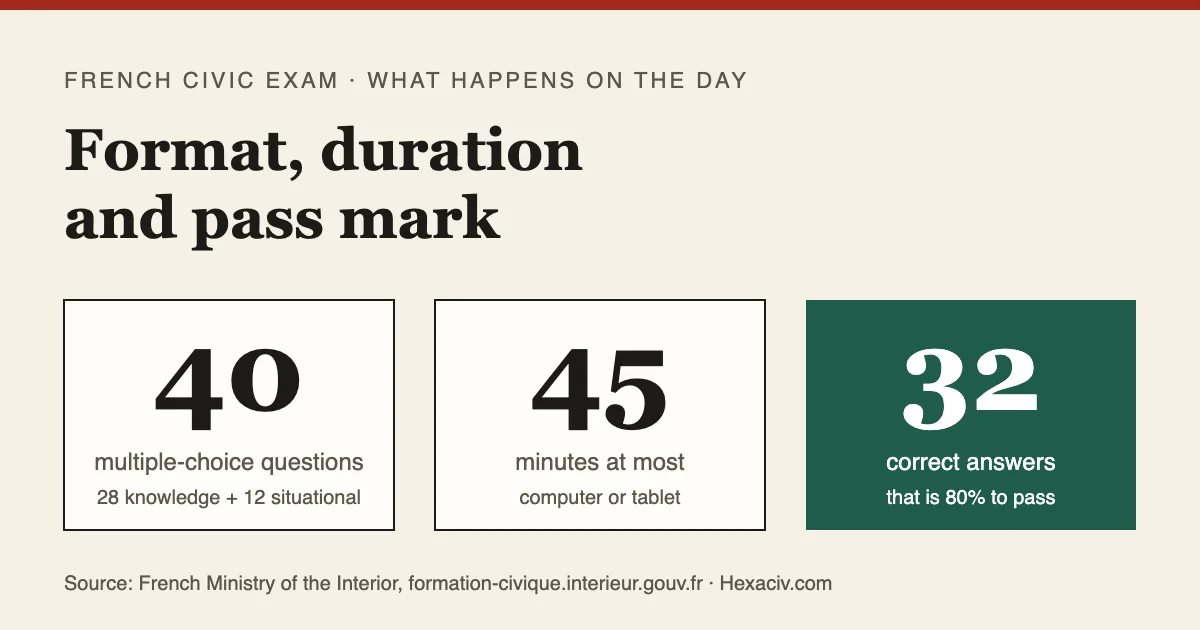
Sources: the Ministry of the Interior, general information on the civic exam (read on 22 October 2026), Service-Public (18 December 2025), Le Français des affaires, CCI Paris Île-de-France (read on 18 October 2026) and the candidate manual of France Éducation international (version B, September 2026, read on 21 October 2026). Page numbers below are from that manual. The French wording is given in brackets where it helps.
The format at a glance
| Point | What the official sources say |
|---|---|
| Number of questions | 40 multiple-choice questions |
| Types of questions | 28 knowledge questions, 12 situational questions (« mises en situation ») |
| Answers | 4 choices, only 1 right |
| Language of the exam | French |
| Length | 45 minutes at most |
| Medium | computer or tablet |
| To pass | at least 32 correct answers (80%) |
| Validity of the certificate | no time limit |
| How many attempts | as many as needed, at any time |
The frame is the same for the three versions of the exam (multi-year residence card, resident card, naturalisation). What changes is the difficulty and the list of knowledge questions. To find out which one applies to you, read who has to take the civic exam.
What happens on the day
- Register on test-civique.fr (your AGDREF number, choice of centre), then contact the approved centre to confirm the registration and pay. Each centre sets its own price, between 60 and 80 euros according to the ministry: the detail is on our page on price, registration and centres. The centre sends you a convocation.
- Arrive on time. If you are late you cannot go in, and you are not refunded (manual, p. 14). Bring a valid ID and your candidate account login (email address and password): without them you cannot sit the exam. Accepted documents, if still valid: the residence permit, or the passport or ID card for citizens of the European Union. An adult without an ID may present certain receipts (residence card application, asylum application with a photograph, international protection); if the ID was lost or stolen, the police declaration receipt with a photocopy (p. 14 and 36).
- Check at the door. Phone off, belongings in the space provided: on the table, only your ID and the computer. The invigilator takes your photo, face visible and uncovered; if you refuse, you do not sit the exam. Everyone starts at the invigilator's signal (p. 14 and 17).
- Answer the 40 questions in full screen (p. 18), on a computer or tablet, in 45 minutes at most. The platform does not let you go back: an answer you have validated cannot be changed (p. 19). You can skip a question without validating it: it comes back at the end. Validating without choosing an answer counts as a wrong answer. If the internet connection drops, the exam pauses and resumes where it stopped. Nobody may leave during the test, except in an emergency or for a health problem reported before the start and backed by a medical certificate (p. 17).
- Download your certificate. The PDF is in your candidate account 12 hours after the exam, with a QR code that lets anyone check it is genuine. It has no expiry date.
- File your application (residence card or naturalisation). Service-Public states that the exam must be passed before you file.
How many questions do you need to get right?
32 out of 40, which is 80%. Only one of the four answers is right. The pass mark therefore leaves a margin of 8 mistakes.
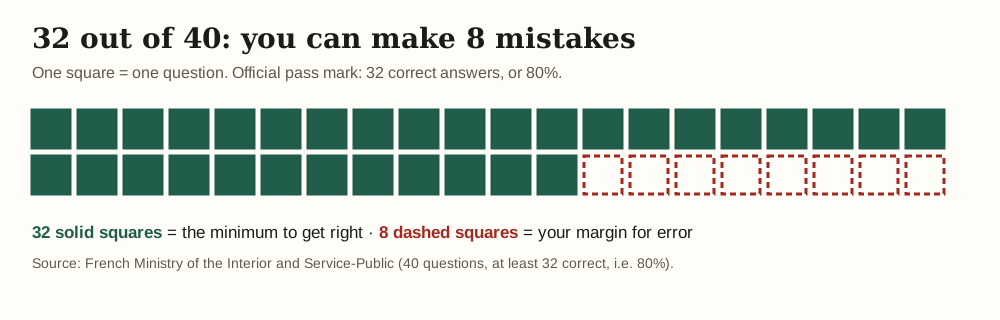
Do not mix up two close numbers. The pass mark is 80%. The average success rate published by the ministry is 81%: in its answer to the National Assembly (11 August 2026) it says 71,125 people had taken the exam by 26 May 2026. About one candidate in five therefore fails, and must then pay for a new registration.
There are no negative points: the candidate manual (p. 13) gives 1 point for a right answer and 0 for a wrong answer or no answer. So answer every question, with a guess as a last resort.
Where the points are: how the 40 questions are split
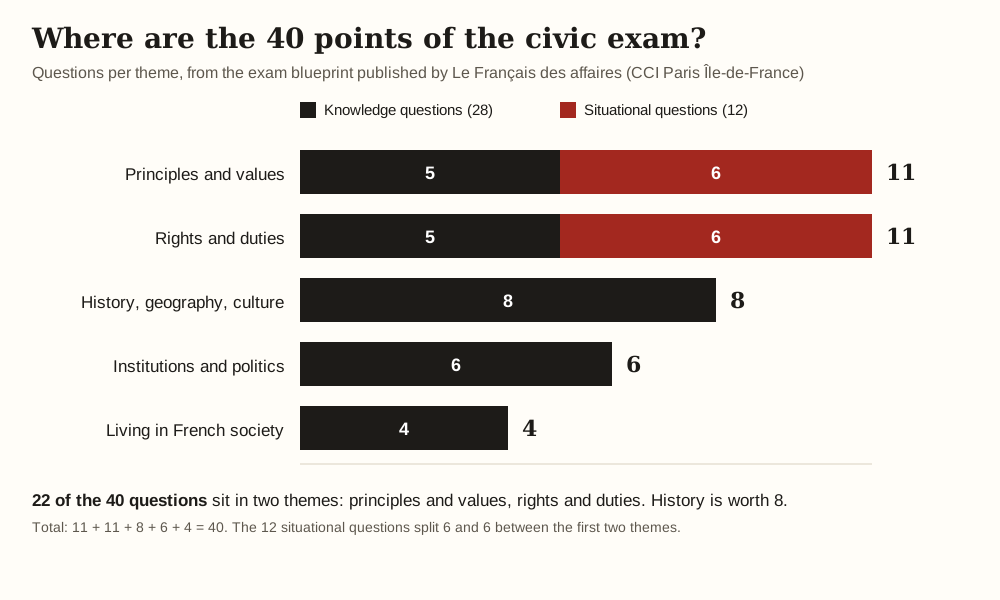
Le Français des affaires publishes the exam blueprint. Two themes hold 22 of the 40 questions, and they are the ones that contain the 12 situational questions.
| Theme | Questions | Published detail |
|---|---|---|
| Principles and values of the Republic | 11 | motto and symbols 3, secularism (« laïcité ») 2, situational 6 |
| Rights and duties | 11 | fundamental rights 2, obligations and duties 3, situational 6 |
| History, geography and culture | 8 | main periods and figures 3, territories and geography 3, heritage 2 |
| Institutions and politics | 6 | democracy and the right to vote 3, organisation of the Republic 2, European institutions 1 |
| Living in French society | 4 | settling in, health, work, parental authority and school: 1 each |
What this changes for your revision: history and geography take a lot of room in the study sheets, but they are worth 8 questions out of 40. Principles, rights and the situational questions are worth 22. A situational question describes a concrete case (at work, at school, with a neighbour) and asks for the right attitude. To practise them, see our corrected situational questions.
Because the exam is in French, a reader who is still learning the language has a second thing to check: whether the French of the questions is clear to them. Questions are short, but the situational ones are several sentences long, with four full answers to read.
And the time: is 45 minutes enough?
45 minutes for 40 questions is about 67 seconds per question (calculation: 2,700 seconds divided by 40). The questions are short multiple-choice items. The trap is elsewhere: you must read all four answers in full, especially in the situational questions, where two answers can both look acceptable.
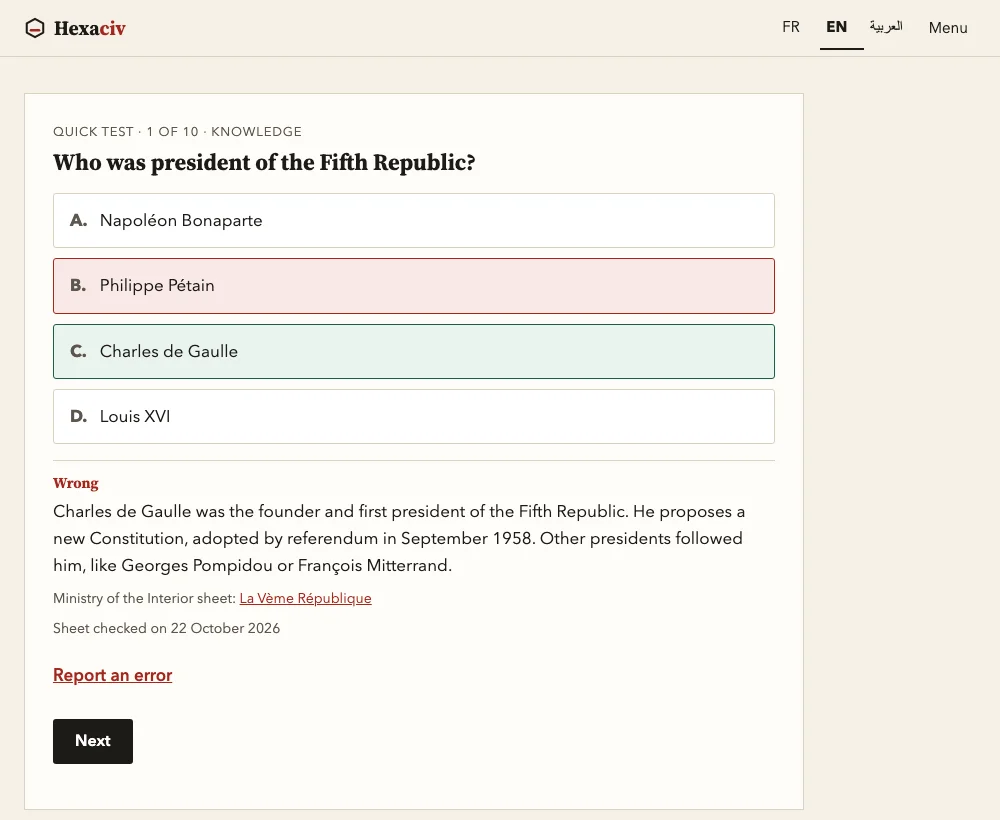
The simplest way to judge your pace is a timed mock exam. Ours follows the format: 40 questions, 45 minutes, no correction before the end.
What if you fail?
The ministry says you can take the exam as many times as needed, at any time. Each new attempt means a new registration and a new payment, with at least 24 hours between two sittings (manual, p. 21). Before booking, our rule of thumb is to aim for 34 out of 40 on two mock exams: that leaves a margin above the 32 pass mark.
Test yourself: 3 questions
For what reason can freedom of expression be limited? (« Pour quel motif peut-on limiter la liberté d'expression ? »)
Right answer: when it disturbs public order (« quand elle trouble l'ordre public »). The law sets this limit. Ministry sheet: the Declaration of the Rights of Man and of the Citizen.
Which is the most serious offence? (« Quelle est l'infraction la plus grave ? »)
Right answer: « le crime ». It is tried by the assize court or the criminal court. Ministry sheet: offences.
Which three powers are separated in a democracy? (« Quels sont les trois pouvoirs séparés dans une démocratie ? »)
Right answer: the legislative (Parliament), the executive (President and Government) and the judicial (judges). They are separated so that no single person holds all the power. Ministry sheet: the separation of powers.
Frequently asked questions
How long is the French civic exam? 45 minutes at most, on a computer or tablet, for 40 questions.
How many correct answers do I need to pass the civic exam? 32 out of 40, which is 80%. You can make 8 mistakes.
Is the civic exam in English? No. The ministry describes it as an exam of 40 questions in French. Our mock exam and corrections are available in French, English and Arabic so you can prepare, but the real questions are in French.
What is the difference between a knowledge question and a situational question? A knowledge question covers a point of the syllabus (a date, an institution, a right). A situational question describes a concrete case and asks what to do. There are 28 knowledge questions and 12 situational questions.
Can I retake the civic exam? Yes, as many times as needed and at any time, according to the ministry. Each attempt needs a new registration and a new payment, with at least 24 hours between two sittings according to the candidate manual.
Does the pass certificate expire? No. The ministry and Le Français des affaires say it has no expiry date. It is available as a PDF 12 hours after the exam (manual, p. 20).
Is the exam the same for naturalisation and for a residence card? The format is the same (40 questions, 45 minutes, 32 correct answers). The difficulty and the list of knowledge questions change with the document you are applying for.
Sources
The rules and their dated changes are in the civic exam change log.
- Ministry of the Interior, general information on the civic exam: format, French language, length, pass mark, validity, number of attempts.
- Service-Public, A new civic exam for foreigners wishing to settle in France, 18 December 2025: the exam must be passed before filing the application.
- Le Français des affaires (CCI Paris Île-de-France), civic exam: everything you need to know, read on 18 October 2026: split of the questions by theme, documents to present.
- France Éducation international, candidate manual for the civic exam, version B, September 2026, read on 21 October 2026: scoring of 1 or 0 point (p. 6, 8 and 13), ID documents (p. 14 and 36), photo and start signal (p. 17), full screen (p. 18), no going back (p. 19), certificate after 12 hours (p. 20), 24 hours between attempts (p. 21).
- National Assembly, written question 11488 and the Ministry of the Interior's answer, 11 August 2026: 71,125 candidates and 81% success rate on 26 May 2026, price of 60 to 80 euros.
Practise in exam conditions before you book your seat.
Take the free mock exam (40 questions, 45 minutes)