French institutions explained in one diagram (civic exam)
France separates three powers. The executive applies the law: the President of the Republic, elected for 5 years, and the Government. The legislature votes it: Parliament, made up of the National Assembly and the Senate. The judiciary checks how it is applied. No two of these powers are held by the same people.
Sources: the Ministry of the Interior's "Institutional and political system" sheets and the Constitution of 4 October 1958, read on 20 October 2026 for the French original of this page. Hexaciv is not an official site and gives no legal advice. The official pages are in French.
The diagram: three powers and the local level
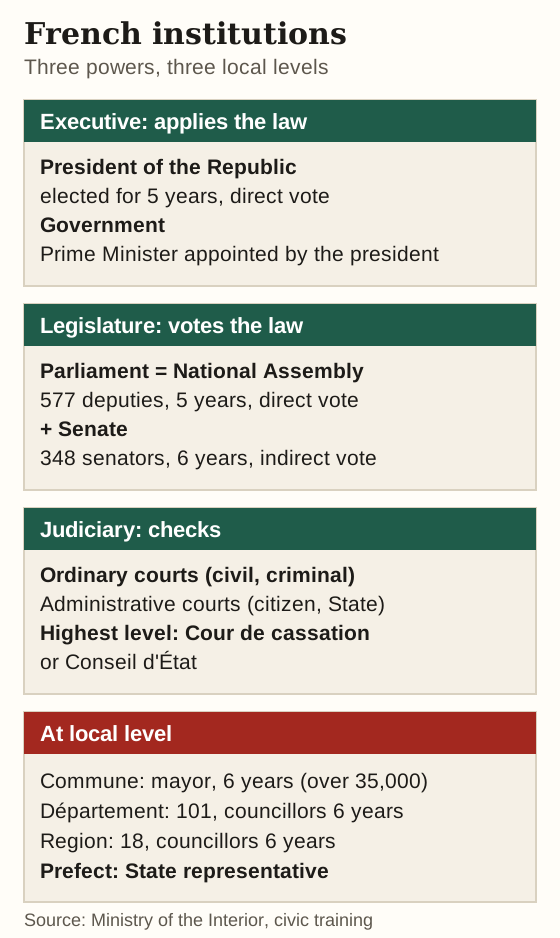
The rule of law means the law is the same for everyone, the State included. According to the Ministry's sheet, a minister who breaks the law can be punished like any citizen.
Who is elected, and for how long?
The official question list has several questions of this kind ("How long is the President of the Republic elected for?", "When are senators elected?").
| Who | Elected by | Term |
|---|---|---|
| The President of the Republic | Citizens, by direct universal suffrage | 5 years |
| The 577 deputies of the National Assembly | Citizens, by direct vote | 5 years |
| The 348 senators | Electors (mayors, municipal councillors, deputies), by indirect vote | 6 years, half renewed every 3 years |
| The mayor and municipal councillors | Citizens, by direct vote | 6 years |
| Département and regional councillors | Citizens, by direct vote | 6 years |
The Prime Minister is not elected: the President of the Republic appoints them (article 8 of the Constitution). To vote you must be a French national, be over 18, have your civil and political rights and be on the electoral roll. For European elections, citizens of the European Union who live in France can vote too.
How a law is passed
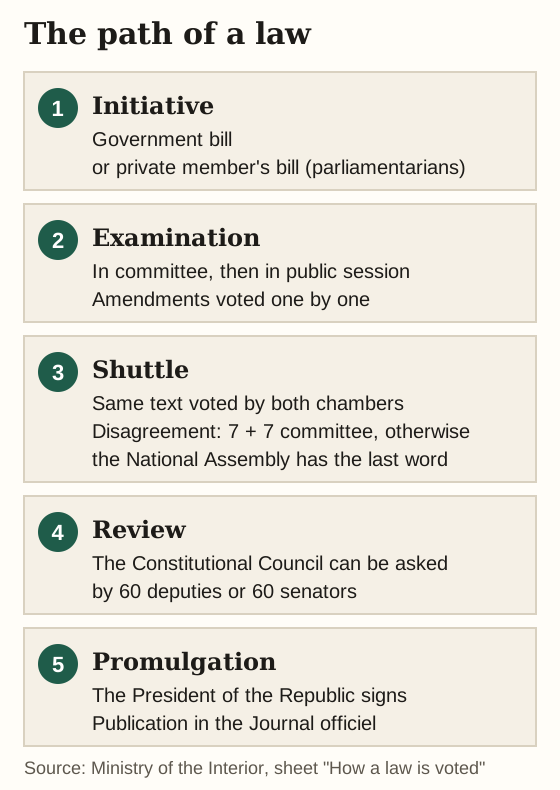
The Government presents a government bill, members of Parliament a private member's bill. The National Assembly and the Senate must adopt the same text. If they disagree, a committee of 7 deputies and 7 senators looks for a compromise, and failing that the National Assembly has the last word. The Constitutional Council can be asked to rule by 60 deputies or 60 senators. The President of the Republic then promulgates the law, which is published in the Journal officiel.
The courts and the local level
There are two court systems. Ordinary justice settles disputes between citizens (civil) and punishes offences (criminal). Administrative justice judges disputes between a citizen and the State. In each system the courts form a pyramid: first instance, appeal, then the supreme court (Cour de cassation or Conseil d'État).
At local level, the Ministry's sheet counts more than 35,000 communes, 101 départements and 18 regions. The prefect represents the State in the département: they issue administrative titles and authorisations and check that local authorities respect the law. The prefect has nothing to do with the courts or the army.
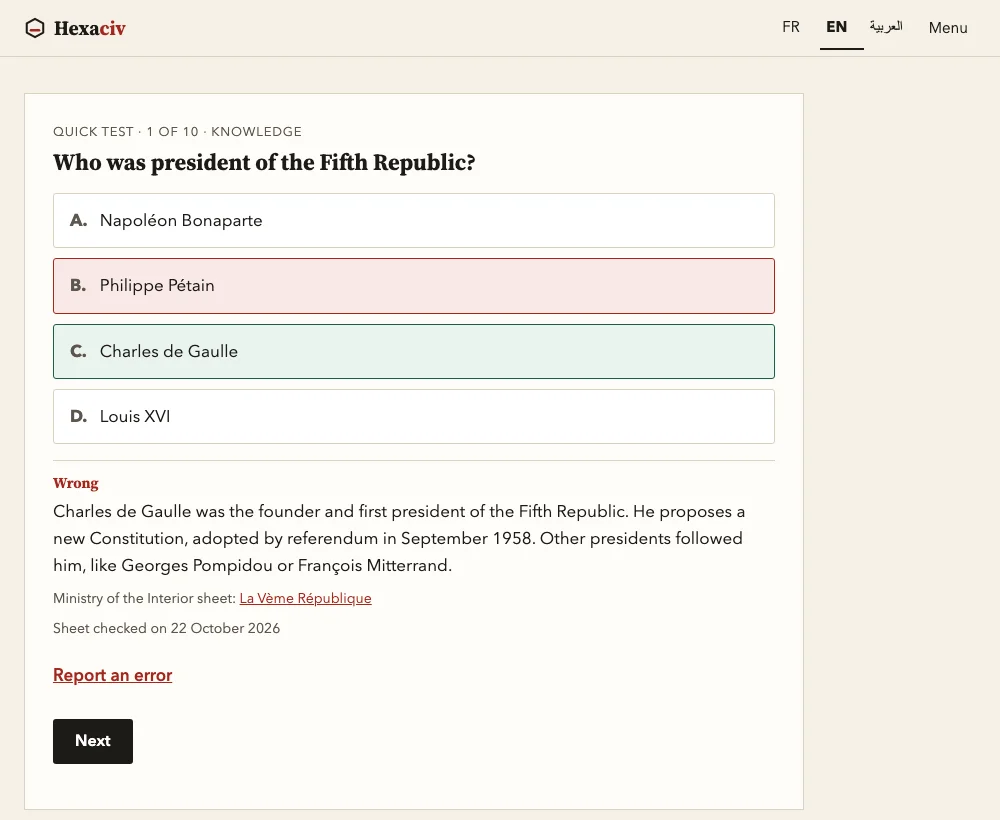
Test yourself: 3 questions
Who appoints the Prime Minister?
Correct answer: the President of the Republic (article 8 of the Constitution).
Who elects the deputies?
Correct answer: citizens, by direct universal suffrage, for 5 years.
Who represents the State in a département?
Correct answer: the prefect, according to the Ministry of the Interior's sheet.
Frequently asked questions
What are the three powers in France? The legislature (Parliament votes the laws), the executive (the Government applies the law) and the judiciary (the courts check how it is applied), according to the Ministry of the Interior.
How many deputies and senators are there? 577 deputies and 348 senators, according to the Ministry's sheet. Together they form Parliament.
How long is the President of the Republic elected for? 5 years, by direct universal suffrage.
Does the president hold all the power? No. The powers are separate and check each other: Parliament votes the law and the judges check how it is applied.
Are the European institutions in this diagram? No. They have their own sheet at the Ministry: this diagram covers only national and local organisation.
Sources
- Ministry of the Interior, "Institutional and political system" sheets: democracy and the Republic, conditions for voting, path of a law, three powers, administrative divisions, prefect.
- Ministry of the Interior, official list of knowledge questions, CSP: 46 "institutional and political system" questions.
- Constitutional Council, Constitution of 4 October 1958, text in force: article 8.
Do you know the diagram by heart? Check it on 40 timed questions, including the ones on institutions.
Take the free mock exam (40 questions, 45 minutes)