Values of the Republic in the French civic exam: 20 questions answered
The official list of the civic exam has 37 questions in the "Principles and values of the Republic" section (multi-year card level). They cover the motto, the symbols, the language, equality, liberty and secularism (laïcité). Here are 20 of them, with the right answer taken from the Ministry of the Interior's sheets.
Sources: the official list of knowledge questions, multi-year residence card level and the "Principles and values of the Republic" sheets of the Ministry of the Interior, read again on 24 October 2026. Hexaciv is not an official site and gives no legal advice. The exam and the official pages are in French: we give the French wording where the exact words matter.
What this section contains, and what we picked
The ministry publishes the questions, not the answers. It does not say which ones come up most often, so we do not claim to show "the most asked". We took 20 of the 37 questions in the section, the ones that cover each of the official sheets. The question wording follows the list (translated here). The answers are written by Hexaciv from the ministry sheet that covers each subject.
Motto, flag, anthem, national holiday
| Question from the official list | Answer and explanation |
|---|---|
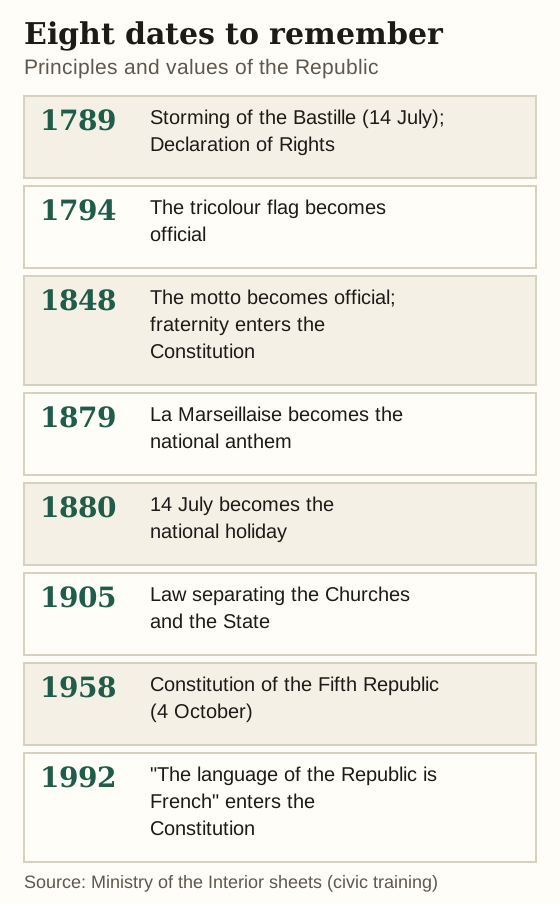
| What is the motto of the French Republic? | Liberté, Égalité, Fraternité. Official since 1848, written into the 1958 Constitution |
| Where can the motto be seen? | On public buildings (town halls, schools, courts), official documents, some coins and stamps. Sheet "The French motto" |
| What colours is the French flag? | Blue, white, red. Three vertical bands; the official flag since 1794 |
| What is the name of the national anthem? | La Marseillaise. Composed in 1792, national anthem since 1879 |
| What is the date of the French national holiday? | 14 July. National holiday since 1880; it recalls 14 July 1789 (storming of the Bastille) and 14 July 1790 (Fête de la Fédération) |
| What is traditionally held on the Champs-Élysées on 14 July to celebrate the national holiday? | A military parade. With the President of the Republic present; it is also a popular festival across the country |
| Who is Marianne? | An official symbol of the Republic. She wears the Phrygian cap; her bust is in every town hall |
| Which animal is a symbol of France? | The rooster (le coq). It is an unofficial symbol, unlike the flag, Marianne or the motto |
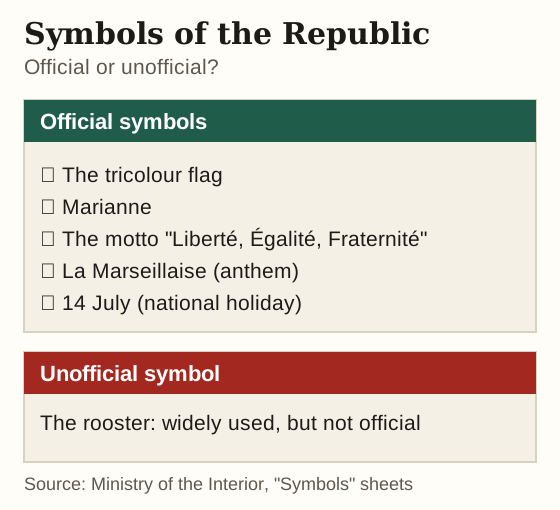
The most common trap is the rooster. It is everywhere (football shirts, the La French Tech logo), but the ministry puts it among the symbols that are not official.
Language, Constitution and regime
| Question from the official list | Answer and explanation |
|---|---|
| What is the official language of the French Republic? | French. "La langue de la République est le français", written into the Constitution in 1992 |
| When does the Constitution of the Fifth Republic date from? | 4 October 1958. The text is titled "Constitution du 4 octobre 1958" |
| "France is an indivisible, ..., democratic and social Republic": complete the sentence | laïque (secular). Article 1 of the Constitution |
| France's regime is: | A democratic Republic. Power is exercised by representatives elected by the people; France is no longer a monarchy |
Regional languages (Breton, Corsican, Alsatian, Basque, Creole) are not official languages: the sheet places them in French heritage.
Liberty, equality, fraternity
| Question from the official list | Answer and explanation |
|---|---|
| What does the word "fraternity" mean in the French motto? | Solidarity between citizens. It first appears in the Constitution of 1848 |
| What is equality? | The law is the same for everyone. Equality before the law, in civic rights and in social rights |
| What does liberty mean? | Everyone can think, speak and live as they wish, without stopping others from doing the same. Guaranteed by the 1789 Declaration of the Rights of Man and of the Citizen |
| Can some jobs be reserved for men? | No. Refusing access to a job because of sex is discrimination (sexism) |
On discrimination, the sheet says French law recognises more than 26 prohibited grounds: origin, sex, physical appearance, age, disability, pregnancy, sexual orientation, political opinions, religion. It adds that treating people in different situations differently is not necessarily inequality: reduced fares for students are one example.
Secularism (laïcité)
| Question from the official list | Answer and explanation |
|---|---|
| What is laïcité? | Freedom of conscience for all and the State's neutrality towards religions. A constitutional principle: Article 1 says France is a secular Republic |
| Can a person freely change religion? | Yes. Everyone is free to have a religion or not, to change it or to give it up |
| Does a person have the right not to believe in a religion? | Yes. The right not to believe is also guaranteed |
| In what year was the law separating the Churches and the State passed? | 1905. The State funds no religion, and religions organise themselves independently |
For schools, the sheet recalls the 2004 law: in public primary and secondary schools, it is forbidden to wear, with the intention of being seen, a sign or garment that shows a religious affiliation.
Three questions to test yourself
Test yourself: 3 questions
What is the name of the French national anthem?
Right answer: "La Marseillaise". It became the national anthem in 1879, according to the ministry sheet.
Which symbol is not an official symbol of the Republic?
Right answer: the rooster. The ministry describes it as an unofficial symbol, widely used.
What does laïcité guarantee?
Right answer: freedom of conscience, that is, to have a religion, to have none or to change. The State is neutral.
How to remember this section
Almost every values question rests on one word to recognise: "fraternité" (solidarity), "égalité" (the same law for everyone), "laïcité" (freedom of conscience and State neutrality). When two answers look alike, rule out the one that reserves a right for one group or that forbids someone to believe or not to believe: it contradicts a principle of the Republic.
Then test yourself on a full exam: the pass mark is 32 correct answers out of 40, see the format, length and pass mark. For more worked examples, open the questions and answers from the official list.
Frequently asked questions
How many questions on the values of the Republic are in the exam? The ministry publishes 37 questions in this section for the multi-year residence card level. It does not publish how many questions from each section are drawn in the exam.
Are the answers on this page official? No. The questions come from the Ministry of the Interior's list, which does not publish answers. The answers are written by Hexaciv from the official sheets.
Is the rooster an official symbol of the Republic? No. According to the ministry, it is an unofficial symbol, unlike the tricolour flag, Marianne and the motto.
Can you change religion in France? Yes. Laïcité guarantees the freedom to have a religion or not, to change it or to give it up.
Where can I find all the questions? On the ministry's site: one list for the multi-year residence card and one for the resident card.
Sources
- Ministry of the Interior, official list of knowledge questions, multi-year card: 37 "Principles and values of the Republic" questions, four-choice multiple-choice format.
- Ministry of the Interior, sheets "Principles and values of the Republic": motto, symbols, language, equality, liberty, fraternity, secularism.
- Conseil constitutionnel, Constitution of 4 October 1958, text in force: Articles 1 and 2.
You have seen 20 questions on values. Now see how 40 mixed, timed questions go.
Take the free mock exam (40 questions, 45 minutes)